
A Chapter in My Late Start Retirement Journey
It was around this time last year.
I’d gone to the office kitchen to pour a cup of coffee and ended up chatting with a coworker. Somewhere in the conversation, he mentioned he was planning to retire soon.
“When are you thinking?”
His answer came faster than I expected.
“Around 62.”
I was a little surprised. This was someone I’d known since I first joined the company after moving to the US — a couple of years older than me, I think. We’d always just been colleagues sharing the same space, so his retirement suddenly felt very real. That conversation is what first got me thinking seriously about the choice between 62 and 70.
“Huh. So he’s retiring now.”
It was interesting, too, in its own way. Around the same time, I got to talking with another coworker on the same team, who also mentioned retiring in a few years. This one was younger than me.
The two of them had something in common. Both had started at this company long before I had, and had spent most of their working lives at this one place. And regardless of whether they were older or younger than me, both were thinking of early 60s as their retirement point.
Hearing that, the natural question followed.
“So when can I retire?”
For Me, It Was a Different Story
Most people, if they can, want to retire early. If financial freedom is secured, there’s no real reason to stay at a job any longer than necessary. Leaving the workforce in your early sixties to do what you want — it’s an appealing story, no question.
But for me, it was a different problem.
I immigrated to the US relatively late. I was already in my early forties when I started my career here. Before that, I’d worked in Korea and Germany. By the time I started thinking seriously about retirement in the US, I was already starting well behind everyone else.
And to be honest, for a long time I was basically financially illiterate. I didn’t really understand how to invest money, how to build a retirement fund, or how Social Security benefits were even calculated.
So retiring in my early sixties felt like someone else’s story. The most realistic path I could imagine was simple: keep working as long as my health allows, and use that time to build up as much retirement savings as possible.
Then I Started Looking Into Social Security
At some point, I started digging into Social Security a little at a time. At first it was a simple question.
“How much can I actually expect to get from Social Security?”
But once I looked at the numbers more closely, another question came up.
“So when should I actually start taking it?”
You can claim Social Security starting at 62. But claim early and your monthly benefit shrinks; wait past your Full Retirement Age and it grows. For anyone born in 1960 or later, Full Retirement Age is 67, and if you wait until 70, you get 124% of your age-67 amount. Past 70, it stops increasing.
My own estimated benefits looked like this:
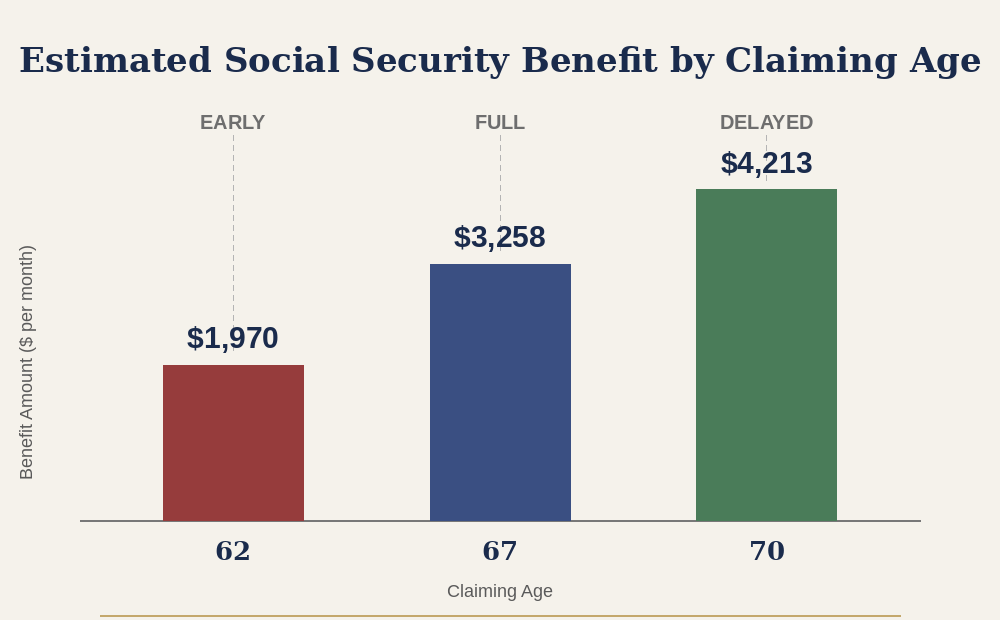
On the surface, it looks simple enough. Claim at 62 and get $1,970 a month. Wait to 67 and it’s $3,258. Wait to 70 and it’s $4,213. But once you start comparing these numbers against each other, things get more complicated.
Claim early, and you collect for more years. Claim late, and each of those later checks is much bigger. So which one actually wins?
Thinking in Terms of Break-Even
The first thing I reached for here was the break-even point.
Say you start at 62. Five years (60 months) at $1,970 a month comes to $1,970 × 60 = $118,200. If you wait until 67 instead, you get nothing for those five years — but from 67 onward, you collect $3,258 a month.
The gap between the 62 and 67 monthly amounts is $3,258 − $1,970 = $1,288. Divide the $118,200 head start by that monthly gap: $118,200 ÷ $1,288 ≈ 92 months, or about 7 years and 8 months. In other words, someone who started at 67 catches up to the person who started at 62 — in cumulative dollars — at around age 75.
I did the same comparison between 67 and 70. Skipping three years (36 months) of the $3,258 benefit means giving up $3,258 × 36 = $117,288. Starting at 70 instead pays $4,213 − $3,258 = $955 more per month. $117,288 ÷ $955 ≈ 123 months, or about 10 years and 3 months. By this simple math, the break-even point lands around age 80.
Of course, this is a heavily simplified calculation. It leaves out taxes, investment returns, inflation and COLA adjustments, Medicare premiums, a spouse’s Social Security, and survivor benefits after death. So none of this should be taken as the definitive answer for an actual retirement decision.
But one thing became clear: when to take Social Security isn’t just a question of “what age should I retire.” It’s a question that stretches out over a much longer horizon than that. That’s really what the choice between 62 and 70 comes down to.
Break-Even: Claiming at 62 vs. 67 vs. 70
When cumulative benefits overtake each other (based on $1,970 / $3,258 / $4,213 per month)
Which Is Where Health Comes In
Beyond this point, the numbers alone stop being enough to decide.
If I retire at 62, I get five extra years of freedom and can start collecting Social Security right away. If I work until 67, I put in five more years, but the benefit is substantially larger. Which is the better choice?
I don’t think the numbers alone can answer that. Health is part of the equation.
Someone who’s healthy at 62 might still have 20, 30 or more years ahead of them. But nobody knows whether they’ll have the same health and stamina at 70 that they have today. And if health problems show up at 62, the whole calculation changes.
So when I think about a claiming age now, I find myself asking less “how much money can I get” and more, “until when, and in what kind of health, will I actually be able to use that money?”
Life Expectancy, the Uncomfortable Variable
In the end, deciding when to claim Social Security comes down to one uncomfortable variable: how long will I live. Nobody can know this for certain.
If I pass away relatively early, claiming at 62 makes sense in terms of lifetime total. If I live healthily into my 80s or 90s, the picture flips — the gap between $1,970 a month and $4,213 a month is enormous.
This matters even more after retirement, when the big income source — a paycheck — disappears. At that point, whether the monthly Social Security check is $1,970 or $4,213 isn’t just a difference in numbers. It’s a difference in lifelong cash flow. In that sense, Social Security starts to look a bit like insurance — the longer you live, the more that gap compounds.
That Doesn’t Mean Working Until 70 Is “The Answer”
I want to be clear about one thing here. I’m not saying “working until 70 is better,” and I’m not saying “claiming at 62 is better” either. Everyone’s situation is too different for that.
Someone with plenty of retirement savings. Someone in poor health. Someone who wants to keep working. Someone who can no longer work. Someone with a spouse’s income and Social Security to lean on. Someone with a pension or investment income on the side. Every one of these situations changes the calculus.
I haven’t made a final decision either. But the numbers 62, 67, and 70 — once a vague blur to me — have become genuinely concrete options I can weigh.
I’m Still Working
I think back to that day in the office kitchen, listening to a coworker talk about retiring. Part of me envied him. Part of me was just struck by it.
“When will I get to do that?”
That’s probably when it started — when retirement stopped being a vague future event and became something I could think about in actual numbers.
I started late. I started my career in the US late, and I started preparing for retirement properly late too. So leaving my job at 62 still isn’t an easy thing for me to picture. But at least now I have some sense of what I need to be weighing.
Retire at 62. Keep working until 67. Or wait for Social Security until 70. And when I weigh that choice, I shouldn’t just be looking at the monthly amount — I need to think about break-even point, health, and life expectancy together.
My eventual decision will probably come down to these three questions:
“How long can I keep working?”
“How long can I stay healthy?”
And finally, “When does it actually make sense for me to start Social Security?”
I don’t have the answer yet. But at least now I’ve started looking at the numbers to find it.