
The Late Starter · September 5, 2026
A Chapter in My Late Start Retirement Journey
While sorting through old pay records recently, I found myself looking at two numbers side by side.
Salary, and 401(k) contribution rate.
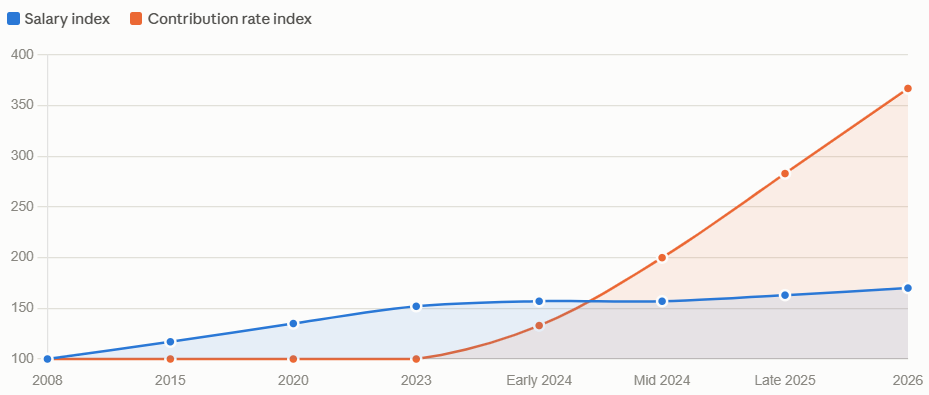
In 2008, my first year working in America, my salary was roughly $90,000. Now, in 2026, it’s roughly $140,000. Over eighteen years, that’s about a 1.7x increase.
Over that same period, my 401(k) contribution rate went from 6% to 22%. That’s about 3.7x.
Salary climbed gently. Contribution rate climbed far more steeply. Lay the two curves side by side, and at some point, they diverge into completely different slopes.
Starting at 6%, and a Long Plateau
In 2008, I started at 6%. For a long time after that, the number barely moved.
Even when I took a $14,000 loan against my 401(k) around 2015 to help with my children’s tuition, I didn’t lower the contribution rate itself. COVID was different. I cut the 6% down to 2%. It lasted just over a year, but at the time, it felt like the only choice available to me.
Once COVID passed, I brought it back to 6%.
For nearly fifteen years, my contribution rate hovered around 6%. In that same stretch, my salary rose steadily — from about $90,000 to roughly $110,000 (2020), and then around $120,000 (2023) — but the percentage going into my 401(k) stayed exactly where it started.
Then, Suddenly, the Curve Got Steep
The change began in 2024.
In early 2024, the contribution rate was 6% Traditional plus 2% Roth, for a total of 8%. Then, starting in the second quarter of that same year, I raised it to 12% — pushing the Roth portion up to 6%.
In the second half of 2025, it moved again, this time to 17%: 7% Traditional, 10% Roth.
And now, in 2026, it sits at 22%: 7% Traditional, 15% Roth.
In just over two years, I raised my contribution rate from 8% to 22% — nearly tripling it. Over that same period, my salary rose by only about 8%.
Add the employer match the company began contributing a few years ago — 8% total (5% non-elective plus 3% match) — and 30% of my paycheck is now going into retirement savings every single pay period.
What the Two Curves Say
In 2008, I was putting about $5,000 a year into my 401(k) — 6% of my salary.
Today, I’m putting in roughly $32,000 a year — 22% of my salary. Add the employer’s share, and it’s about $43,000 a year.
Same person. But the pace at which money flows into retirement savings is now roughly 8.5 times faster.
Laying these two curves side by side, I think I understand what they’re telling me. My salary didn’t drive this. My decision to save did — and it moved far faster than my paycheck ever did.
Looking back, the reason is simple. My salary is something the company decides. My contribution rate is something I decide. And the closer retirement gets, the more I’ve realized: the one thing I can actually control isn’t the market’s return. It’s how much I choose to put in.
The Only Lever Someone Starting Late Really Has
If I’d started early, a gentle 6% curve might have been enough. Time would have done the compounding for me.
But I didn’t have that time. So there was only one thing left to do: grab the one lever I could actually move myself — the contribution rate — and pull it as hard as I could.
Let the salary curve stay gentle. Make the contribution curve steep instead. That was, for someone starting late, almost the only choice available.
Both curves are still being drawn today. The only difference now is that I’m the one deciding their slope.