
A Chapter in My Late Start Retirement Journey
In 1996, I earned my Ph.D. and joined Samsung Electronics — my first job out of school.
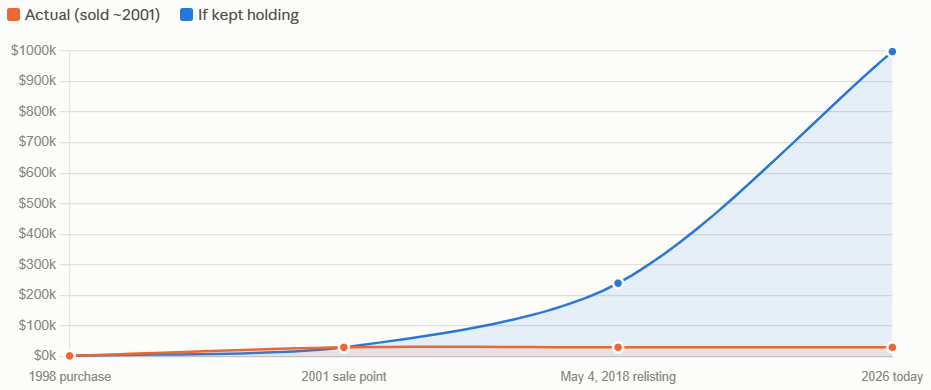
The following year, the 1997 Asian financial crisis hit South Korea, and companies across the country were laying off employees. Samsung was no exception. By late 1998, the company needed to raise capital, and it issued new shares — offering employees the chance to buy company stock at a 30% discount, based on rank. As a manager-level employee, I was allotted 100 shares.
The stock was trading at around $20 a share at the time. I bought my 100 shares.
The price rose quickly after that. By the time I left Samsung to take a research position in Germany, the stock had climbed to around $300 a share.
That’s when I made my first real investing mistake: I sold everything before I left Korea.
At the time, it seemed reasonable. The stock had already risen so much — surely it couldn’t keep climbing forever.
What I Left on the Table
Years later, Samsung carried out a massive stock split — one share became fifty. Had I held onto my original 100 shares, they would have become 5,000. At today’s value, that position would be worth somewhere around $1 million.
That number alone would have essentially completed my retirement.
I know this kind of hindsight math means nothing. It’s a story I can tell myself, but not a mistake I can undo. And honestly, I don’t feel much regret over it — because I’m certain that even if the same opportunity came around again, I wouldn’t have had the financial knowledge back then to hold on that long anyway. Without understanding what I owned or why, I would have sold early one way or another.
A Free Share, and a Familiar Pattern
Some years ago, a coworker sent me a referral invite for Robinhood. New users who signed up could pick a country from a list and receive one random free share of stock. Mine happened to be Apple — back when it was trading at under $50 a share.
That small windfall got me experimenting with investing again, in small amounts, almost as practice. But I was still financially illiterate. I bought and sold without any real strategy, watched my balance rise for a while, and then watched it settle right back down again.
What I’ve Learned
Short-term trading, done without financial literacy, is not fundamentally different from betting at a casino. Over time, the odds work against you. No one — no expert, no algorithm, no seasoned trader — can reliably predict the market’s short-term swings.
I didn’t understand that back then. I’m not sure I fully understood it even after the Apple experiment. It took years, and a slow accumulation of small lessons, before I stopped treating the market as something to time and started treating it as something to hold.
Looking back, I don’t carry the weight of the Samsung shares I sold too early, or the Robinhood balance that came and went. What I carry instead is the lesson underneath both stories: the market doesn’t reward guessing. It rewards patience, and it rewards understanding what you actually own.
I’m still learning that lesson. I suspect I always will be.