
The Late Starter · August 30, 2026
A Chapter in My Late Start Retirement Journey
It was my first year working in America.
My company held a 401(k) information session for new employees, along with an opportunity to meet one-on-one with a financial advisor from the company that managed our retirement plan.
At the time, I didn’t know what a Traditional IRA was. I didn’t know what a Roth IRA was, either. With the advisor’s guidance, I signed up for a 401(k) and started contributing 6% of my salary. It seemed like the responsible thing to do. At least, I thought that was what a responsible employee was supposed to do. Then, the following year, when I was doing my taxes, my CPA looked at my W-2 and asked me a question I wasn’t expecting.
“Do you plan to keep working in the United States?”
She was looking at the 401(k) contribution listed on my W-2. I didn’t understand why that mattered. Only later did I learn why. Money in a 401(k) generally can’t be withdrawn without a penalty before age 59½. At the time, I had no idea whether I would stay in America permanently. If I had understood that detail from the beginning, I might never have enrolled in a 401(k) at all.
Looking back, that thought still makes me a little uneasy.
I came surprisingly close to walking away from something that would eventually become so important to my future, simply because I didn’t understand it.
When Life Got in the Way
In 2008, the recession hit.
For more than a year, the entire company took a 10% pay cut. I had just bought a car and a house. With a mortgage and a car loan to pay, money was tight. So I made a decision. I reduced my 401(k) contribution from 6% to 2%. At the time, it felt like something I had to do. And maybe it was.
A few years later, my children started college. This time, tuition became the problem. Student loans began piling up each semester, along with high interest rates. To ease the burden, I made another decision I hadn’t expected to make. I took out a loan against my own 401(k).
The interest rate was about 4%, which at the time was much lower than the alternatives available to me. Looking at each decision individually, they all made sense.
Reduce the contribution. Take the loan. Solve the problem in front of me. But there was one thing I never did throughout all of this.
I never stopped to think about what these decisions would mean for my retirement.
I didn’t calculate it. I didn’t project how much I would eventually have. For more than ten years, I don’t think I even knew how much money was in my own 401(k).
Slowly, I Started to Wake Up
At some point, I began overhearing conversations at work. One coworker mentioned that he was contributing 10% to his 401(k). Another said 14%. These were numbers I had never thought to compare myself to before. I had never even asked myself:
How much am I contributing?
Around the same time, I slowly—and somewhat uncomfortably—began to realize something else. I had never really learned anything about personal finance.
Not in school. Not at home. Not anywhere. Looking back, that seems strange.
I had earned a Ph.D. I had built a career as an engineer. I spent my days solving complicated technical problems. Yet no one had ever taught me how to manage the money I would earn over the course of my life. Then one day, our church announced a new program.
Dave Ramsey’s Financial Peace University.
I encouraged my son to participate. One day, he brought the workbook home. I picked it up out of curiosity, without thinking much about it. Then I started reading. I ended up reading the entire thing in one sitting.
Looking back, that was probably the beginning of the end of my financial illiteracy. There was no dramatic turning point. Nothing suddenly changed my life. It was simply a book sitting on the table, and a father who happened to pick it up.
Catching Up
After that, something began to change. Whenever I received a raise, I put the increase toward my 401(k) contribution.
A little more. Then a little more. Year after year.
During that time, my company was acquired by larger companies several times. With each change, the 401(k) matching improved, and my salary grew as well. Little by little, I increased my own contribution.
Today, I contribute 22% of my salary to my 401(k).
My employer contributes another 8% through its match. So, in total, about 30% of my income goes toward retirement savings. But the important number for me isn’t 30%.
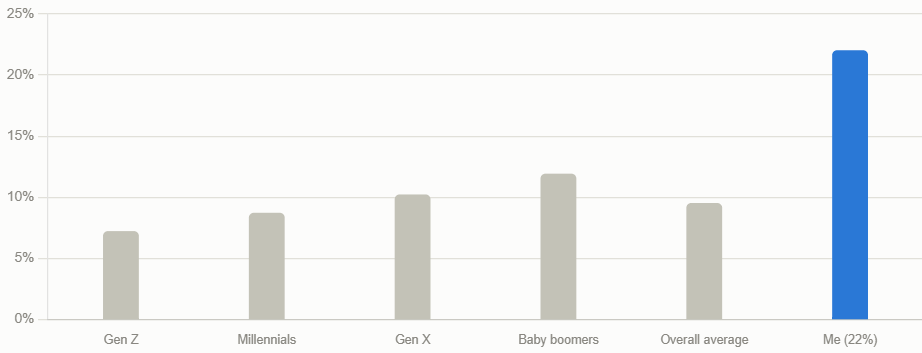
It’s the 22% that comes out of my own paycheck.
I recently looked at some data on 401(k) contribution rates in the United States. The average employee contribution appears to be somewhere around 7–9%. Even when employer matching is included, total retirement savings are generally around 12–14%.
By those measures, my 22% contribution is quite high. But when I look at that number, I don’t feel particularly proud. If anything, I feel a little bittersweet.
I’m not contributing 22% because I have an unusually large amount of money to spare.
I’m doing it because I started too late. I didn’t have enough time in my 20s and 30s for compound growth to work in my favor. The years I missed can’t be recovered. So now I have to make up for some of that lost time by putting a much larger portion of my income toward retirement.
If I had started earlier, I could have reached the same destination with a much smaller contribution rate. But I didn’t start early. So now I have to contribute more.
That’s the price of starting late.
What 22% Really Means
This didn’t happen overnight. It happened slowly over the past several years. And honestly, I didn’t fully notice it happening. When my salary increased, I increased my contribution. The following year, I increased it again. Then again.
A few years passed, and when I finally stepped back and looked at the numbers, I realized that I was contributing 22%.
There is something strangely comforting about watching that 22% come out of every paycheck. At least I’m doing something now. That’s how it feels. But there is also a very real cost. It means living a little more carefully today. There are things I have to pass up. There are times when I have to choose to leave money for the future rather than spend it today. Both things are true at the same time.
The 22% gives me a sense of security about the future. But it also means giving up some of what I could spend today.
That 22% is more than a savings rate.
It is the price of choosing the future over some of today’s spending. And now, at least, I understand where that price came from. I started too late.
A Young Engineer, and a Familiar Story
A few years ago, a young engineer joined our company. He was Vietnamese. He had earned his Ph.D. in Germany and had worked for another U.S. company for several years before joining us. He was considerably younger than me.
One day, I asked him about the 401(k) he had at his previous employer. He told me he had started contributing to one. But he had no idea what had happened to the money since then. He didn’t know that he could move the old 401(k) into his new employer’s plan or another retirement account after leaving his previous job. He had simply left it there.
Like moving to a new address and never checking what happened to the mail that kept going to the old one. As I listened to him, I saw a little of myself in his story. Educated. Career-focused. Hardworking. Always looking ahead.
And yet, when it came to money, I knew almost nothing. Maybe this is more common than we like to admit. Among engineers. Among immigrants. Among people like me who came to America to build a career and spent years working hard to create a stable life.
We study hard. We build good careers. We learn how to solve complicated problems. And yet, somehow, many of us remain strangers to our own financial future. Until one day, we aren’t.
I started too late. And that’s why I’m saving more now. The number 22% isn’t a number that represents my success. If anything, it represents the time I lost. But it also tells another story.
Starting late doesn’t mean you can’t do anything.
I can’t turn back the clock. But I can change what I do today. So I’m going to keep trying to catch up. I may never do it perfectly. But at least I don’t want to hide behind the word “later” anymore. Now I know where I started. I know how late I am. And little by little, I’m learning what I need to do next.
22%.
To me, it’s more than a contribution rate. It’s the price I’m paying for starting late. And at the same time, it’s proof that I haven’t given up.